
Pricing/product information checked: 10 September 2026.
BrightLocal remains a capable local SEO platform for agencies, particularly for rank tracking, citation work, reviews, audits, and white-label reporting.
Agencies look elsewhere when they need broader listings distribution, multi-location scale, or reseller infrastructure.
Others switch for deeper SEO data, automated GBP management, or a different commercial model.
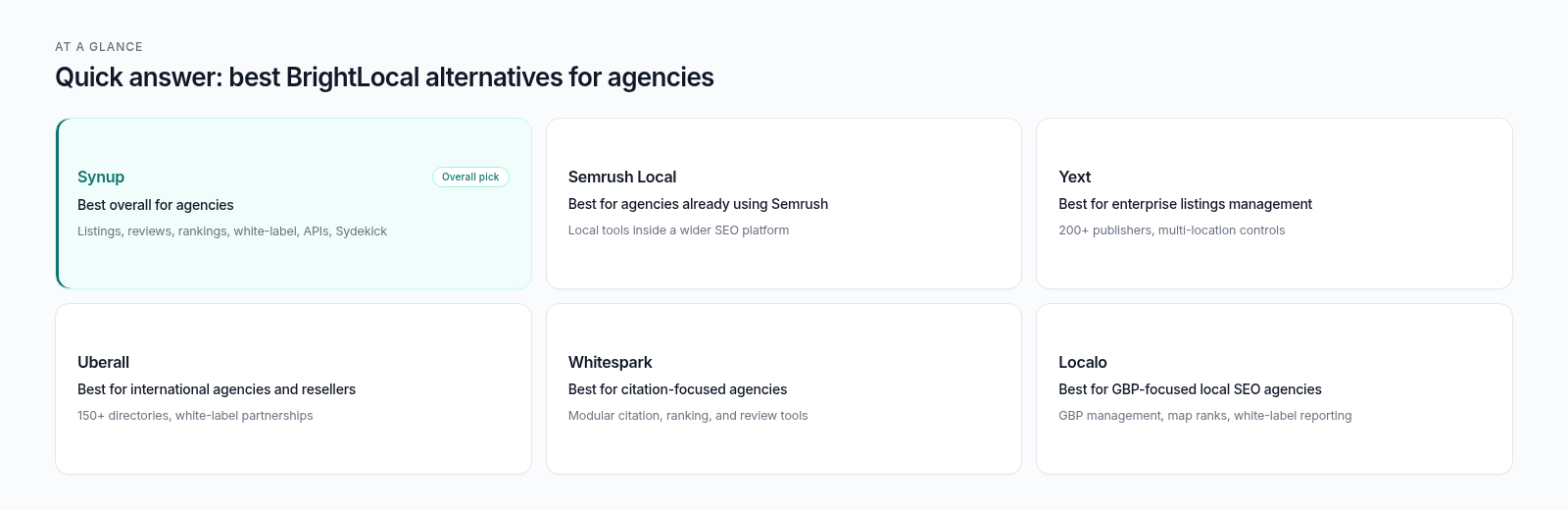
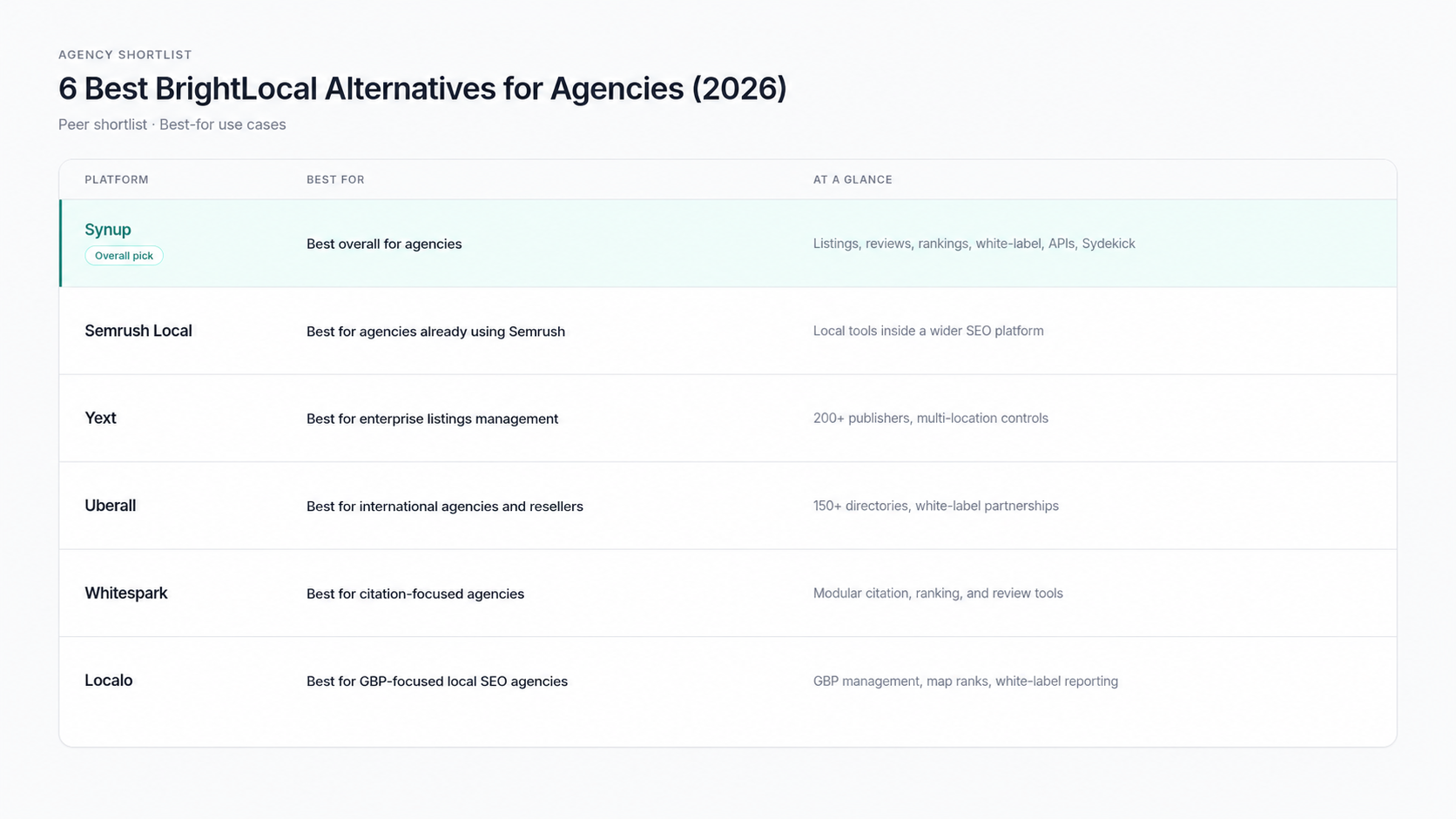
If you need a BrightLocal alternative for agency work in 2026, the shortlist is Synup, Semrush Local, Yext, Uberall, Whitespark, and Localo. These BrightLocal alternatives cover listings, citations, rankings, reviews, and multi-client delivery in different ways.
Synup is our strongest all-round pick because it combines listings, reviews, local rank tracking, agency white labeling, client management, APIs, and the Sydekick AI agent.
Quick Answer: Best BrightLocal Alternatives for Agencies in 2026
Synup is the strongest overall BrightLocal alternative for agencies that need listings, reviews, rankings, white-label delivery, and automation in one stack. BrightLocal can still win when audits, citation campaigns, and geo-grid ranking intelligence are the core of the retainer.
Synup: Best overall for agencies. Combines listings, reviews, rankings, white-labeling, client management, APIs, and agent-based local marketing automation.
Semrush Local: Best for agencies already using Semrush. Adds listing distribution, review management, GBP automation, and map rank tracking to a wider SEO platform.
Yext: Best for enterprise listings management. Covers 200-plus publishers globally with multi-location controls and reseller or partner options.
Uberall: Best for international agencies and resellers. Built around multi-location marketing, white-label partnerships, listings, reviews, social, and 150+ directories.
Whitespark: Best for citation-focused agencies. Modular tools and one-time citation-building services let agencies pay specifically for citations, rankings, or reviews.
Localo: Best for GBP-focused local SEO agencies. Strong Google Business Profile management, local rank maps, reviews, citations, client access, and white-label reporting.
How We Evaluated These BrightLocal Alternatives
We evaluated each platform for a US agency managing local SEO across multiple clients.
Material claims about features, coverage, and pricing were checked on vendor websites, pricing pages, product documentation, help centers, and partner materials as of 10 September 2026.
The ranking does not assume every competitor should mirror BrightLocal. Whitespark sells separate citation, ranking, GBP, and review products. Yext and Uberall emphasize enterprise location data. Localo emphasizes GBP optimization and map visibility.
BrightLocal Alternatives Comparison Table
Sources (retrieved 10 September 2026):
What Are BrightLocal Alternatives?
BrightLocal alternatives are local SEO and listings-management platforms an agency may use instead of BrightLocal for listings, citations, local rank tracking, reviews, reporting, and multi-location work.
BrightLocal combines rank tracking, audits, citation monitoring and building, listing synchronization, GBP tools, review management, and white-label reporting for multi-client agency work. Public pricing is clearest for Managed SEO ($1,299/mo) and Citation Builder (from about $3.20 per site, with lower bulk rates). Self-serve Track and Manage-style platform access is sold on the site, but dollar stickers for those tiers are not always shown as simple public list prices. Agencies switch for stronger continuous listings distribution, multi-location controls, reseller capabilities, different citation economics, broader SEO functionality, or more automation.
Best BrightLocal Alternatives for Agencies in 2026
1. Synup
Best for:
Agencies that want listings, reputation management, local SEO, white-label client delivery, and automation in one platform.
Features:
Synup is the strongest overall BrightLocal alternative here for agencies that want to go beyond local SEO reporting and run more of the work inside one system.
Its listings platform syndicates location data across a network that Synup materials describe as 100+ directories and publishers spanning 50+ countries, including Google Maps, Apple, Bing, Facebook, Waze, HERE, TomTom, and other discovery and navigation services. Agencies can manage portfolios from one dashboard, monitor listing health, detect duplicates, make bulk changes, track local rankings, and generate white-label client reports. White labeling is available from Premium upward. Synup also supports review monitoring and generation, local rank grids, social publishing, APIs, client portals, team permissions, custom branding, and MCP support.
A major 2026 addition is Sydekick AI: The Agent for Local Marketing, an agent for work across listings, reviews, social, local SEO, reporting, and AI-search visibility, with skills, playbooks, approvals, and an audit trail.
Limits:
Synup can cost more than BrightLocal or a narrow citation or rank-tracking product if an agency only needs one or two functions. Pricing also combines conventional software with Sydekick usage credits. When included credits are exhausted, Sydekick activity pauses until credits are replenished, so heavy automation buyers should model credit use rather than subscription price alone.
Pricing:
Solo starts at $49/mo for 1 location. Premium is $299 for up to 10, Pro $499 for up to 25, and Scale $899 for up to 50. Enterprise applies above 50. See Synup Pricing.
Choose if:
You want to replace BrightLocal with a broader agency platform for continuous listing distribution, reviews, rankings, reporting, client access, and workflow automation.
2. Semrush Local
Best for:
SEO agencies already using Semrush for keyword research, technical SEO, competitive analysis, or client reporting.
Features:
Semrush Local fits agencies that already run SEO inside Semrush and need listings, reviews, GBP tools, and map ranks in the same stack.
Local Pro includes Listing Management, Review Management, advanced Google Business Profile management, and Map Rank Tracker. Semrush says Listing Management distributes business information across 70+ directories. Local tools also support duplicate management, review generation and monitoring, automated review responses, and map-rank tracking.
Semrush's GBP AI Agent can create and publish GBP posts, upload photos, and handle review replies. Agencies can organize client locations through Semrush projects and folders. Local Pro also exposes Listing Management through Semrush's Local API.
Limits:
Semrush Local is priced per location, which gets expensive for large portfolios of small clients. Fifty Local Pro locations at $60 each would be $3,000 per month before other Semrush subscriptions. The local offering sits inside a much larger marketing suite, so citation-only agencies may buy more software than they need. Listing Management sits on Local Pro, not Local Base.
Pricing:
Local Base is $30 per location per month billed annually. Local Pro is $60 per location per month billed annually. Local Business is custom. See Semrush Local Pricing and the pricing and plans KB.
Choose if:
Your agency already relies on Semrush and wants local SEO beside broader SEO and competitive research workflows.
3. Yext
Best for:
Agencies serving large multi-location businesses, franchises, and enterprise brands.
Features:
Yext approaches local search from an enterprise location-data perspective rather than as a traditional local SEO toolkit.
Its Listings product reaches 200-plus publishers globally, spanning maps, search, social, directories, and newer AI-driven discovery surfaces. Agencies can keep NAP, hours, and categories consistent across many consumer-facing destinations.
The wider platform covers Listings, Reviews, Social, Pages, analytics, and Knowledge Graph functionality. Agencies selling multi-location retainers can package several modules without stitching separate vendors for reviews, pages, and listing sync.
Yext offers reseller and channel partner programs with APIs, automation, onboarding support, and commercial packaging for Listings, Reviews, and related services. Role-based access and location hierarchies help franchise and multi-brand teams keep regional managers inside their scope while central teams retain governance.
Limits:
Yext is less attractive when straightforward pricing matters. It does not publish a simple self-service per-location price comparable with Synup, Semrush Local, or Whitespark, so agencies need a commercial proposal to understand margins. Enterprise controls can also be more than a small agency needs, and implementation overhead rises with publisher count and custom workflows. Compared with BrightLocal, Yext places less emphasis on citation audits, geo-grid rank reporting, and agency-friendly local SEO campaign tooling as the primary product story.
Pricing:
Custom quote, based on products, location count, publisher requirements, and commercial relationship. Start from Yext Listings.
Choose if:
Your main reason for leaving BrightLocal is managing hundreds or thousands of locations with extensive publisher coverage, governance, roles, APIs, and enterprise controls.
4. Uberall
Best for:
International agencies, white-label resellers, franchises, and agencies serving complex multi-location brands.
Features:
Uberall fits when location count, markets, and reseller delivery outgrow a classic local SEO suite.
Its Listings Management product covers 150+ directories, with public materials highlighting Google and Apple among that network, plus broader directory, maps, social, and discovery destinations.
Uberall supports centralized updates, duplicate suppression, profile protection, location optimization, and API synchronization. Agencies can update hours, menus, and store status across markets from one workflow.
The platform extends beyond listings into review management, local social publishing, analytics, local pages, store locators, and AI-search visibility. Agencies selling a full location marketing stack can keep more of that work in one partner environment. Its partner program includes agencies and resellers that want to offer Uberall products as white-labeled services. Technology partners can connect through APIs, and approval workflows help larger teams limit unauthorized public edits while giving field marketers limited self-serve access.
Limits:
Uberall is designed mainly around multi-location and enterprise workflows. An agency managing a small portfolio of independent local businesses may not need its full model. Price transparency is limited, so agencies cannot calculate a reliable cost per client from the public website alone. Compared with BrightLocal, Uberall places less emphasis on inexpensive self-serve local SEO tooling for audits, citation campaigns, and geo-grid reporting. Sales-led packaging and implementation planning are part of the buying process.
Pricing:
Custom quote, based on package, location count, market, and optional capabilities. See Uberall Pricing.
Choose if:
You need international coverage, white-label reseller capabilities, multi-location governance, and broader location marketing around listings.
5. Whitespark
Best for:
Agencies that prioritize citation research, manual listing cleanup, GBP management, and local rank tracking.
Features:
Whitespark is conceptually close to BrightLocal but packages tools differently. It sells Local Citation Finder, Local Rank Tracker, Local Ranking Grids, Reputation Builder, Local Platform, and Listings Service separately.
Local Citation Finder helps agencies discover citation opportunities, monitor existing citations, compare competitors, and export results. The Agency plan supports 20 campaigns and 40 searches per day and includes white-label export.
Listings Service takes a manual approach to citation cleanup and building. US packages currently range from $399 per location for Premium to $999 for Ultimate, with custom orders starting at $20. Local Rank Tracker includes white-label URLs, custom agency domains, email reports, and CSV/PDF exports.
Limits:
Whitespark is not an all-in-one BrightLocal replacement in the conventional SaaS sense. Citation research, listings services, rank tracking, GBP management, and reputation tools may involve separate subscriptions or one-time purchases. Manual listings work can also be slower than always-on syndication. BrightLocal can still win when an agency wants audits, geo-grid ranking views, citation work, and white-label reporting bundled in one familiar local SEO workflow rather than assembling Whitespark modules a la carte.
Pricing:
Local Citation Finder Agency costs $59 monthly or $49 per month billed annually. Local Platform starts at $1 per location per month, Local Ranking Grids at $10 monthly, and Listings Service from $20 one-time. See Whitespark Pricing and Local Citation Finder.
Choose if:
You want granular control over what you buy and prefer citation-focused workflows over a broad recurring listings subscription.
6. Localo
Best for:
Agencies centered on Google Business Profile optimization, local map rankings, citations, reviews, and client reporting.
Features:
Localo is a lighter BrightLocal competitor aimed at agencies, freelancers, and local businesses that sell Google visibility as a service.
Its workflow centers on Google Business Profile management and local map visibility rather than enterprise publisher syndication. Agencies can organize multiple client profiles, monitor local keyword rankings, optimize profiles, manage reviews, publish content, track competitors, create white-label reports, manage citations, and prospect for new clients.
Localo's Position Map shows how a location ranks at different points in a local search area instead of one city-wide position. Reporting can create weekly or monthly client reports with rankings, GBP statistics, competitor information, and completed work. Pro plans add team and client access, reports management, bulk posting, and client-acquisition tools. The Citations Manager tracks directories and NAP inconsistencies, while Smart Tasks and an AI Agent guide weekly GBP work.
Limits:
Localo's citation model differs from network-syndication platforms such as Synup, Yext, Uberall, or Semrush Local. It helps identify, create, organize, and track citations, but much of the work still involves interacting with directories. That makes Localo more of a local SEO execution platform than enterprise listings infrastructure.
Pricing:
Single Business is $49 monthly or $39 per month on annual billing. Pro is $169 monthly or $149 per month billed annually, with capacity framed by GBP profile count (roughly 2 to 120 profiles depending on plan framing; confirm current caps on the pricing page). Enterprise is custom. See Localo Pricing.
Choose if:
Your agency mainly sells GBP optimization, map-rank improvement, review management, citation work, and branded reporting rather than large-scale publisher syndication.
BrightLocal vs Synup
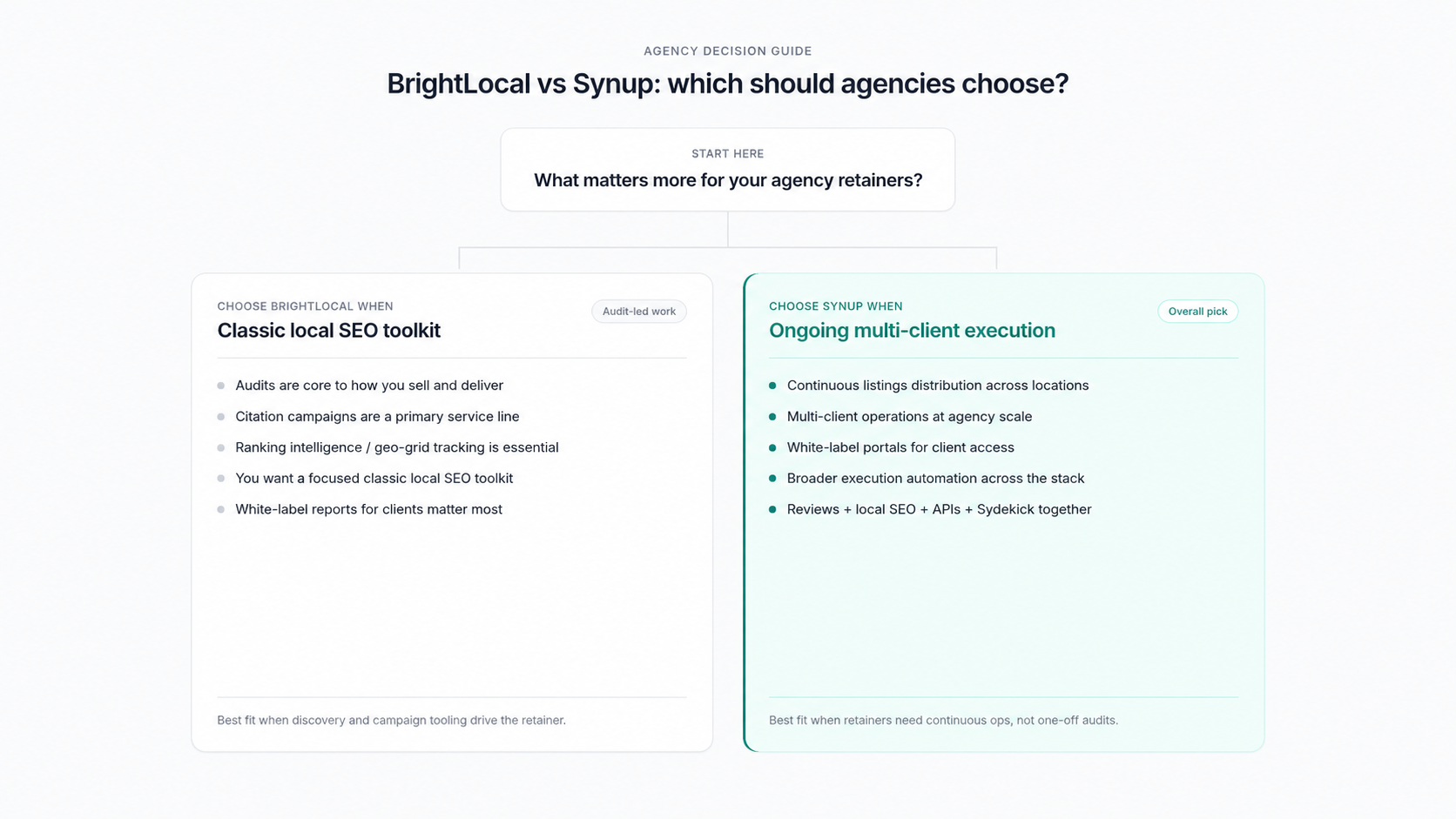
Synup is the stronger BrightLocal alternative when continuous listings distribution, multi-client operations, white labeling, and broader execution automation matter more than a classic local SEO toolkit alone.
BrightLocal is strong for audits, geo-grid rankings, citation work, reputation, key listing sync, and white-label reports. Synup emphasizes continuous publisher distribution, branded client portals, and combining listings with reviews, local SEO, social, APIs, and agent-driven workflows.
Choose BrightLocal if audits, citation campaigns, and ranking intelligence are central. Choose Synup if listings distribution, multi-client operations, white labeling, and execution automation matter more.
BrightLocal vs Yext
Yext is the better BrightLocal alternative when the buying problem is enterprise listings infrastructure rather than day-to-day local SEO campaign tooling.
BrightLocal combines rankings, citations, reviews, audits, and reporting for small and midsize agencies, with clear service pricing for Managed SEO and Citation Builder. Yext reaches 200-plus publishers globally, with enterprise permissions, APIs, reseller or partner programs, and multi-location controls. For 15 independent local businesses, BrightLocal may be easier. For 2,000 franchise locations, Yext's governance and publisher coverage can matter more.
BrightLocal vs Semrush Local
Semrush Local is the better BrightLocal alternative when local work must live inside a wider SEO platform your team already uses every day.
BrightLocal is more specialized in local SEO. Semrush becomes attractive when the same team already does keyword research, competitive analysis, technical SEO, and reporting inside Semrush. Local Pro adds listings, reviews, GBP management, and Map Rank Tracker at $60 per location per month billed annually. The trade-off is cost at scale under per-location pricing.
BrightLocal vs Uberall
Uberall is the better BrightLocal alternative when the operational problem is multi-location marketing and reseller delivery rather than self-contained local SEO campaigns.
BrightLocal aligns with agencies needing straightforward reporting, citations, rankings, and reputation tools. Uberall is built around multi-location marketing and reseller operations, with directory coverage, APIs, white-label partner offerings, approval workflows, local pages, social, and enterprise governance. BrightLocal has clearer public service pricing. Uberall wins when managing hundreds or thousands of locations.
BrightLocal vs Whitespark
Whitespark is the better BrightLocal alternative when citation research and modular, pay-for-what-you-need tools matter more than a single bundled local SEO suite.
BrightLocal packages audits, rankings, citations, reviews, and reporting in one agency-oriented platform. Whitespark sells Local Citation Finder, rank tracking, GBP tools, reputation tools, and manual Listings Service separately.
Choose BrightLocal for one primary local SEO workspace. Choose Whitespark for granular control over citation campaigns, one-time listing cleanup, and modular add-ons.
BrightLocal vs Localo
Localo is the better BrightLocal alternative when GBP optimization, map-rank visuals, and client reporting are the core service rather than broad publisher syndication.
BrightLocal covers a wider classic local SEO toolkit. Localo concentrates on Google Business Profile execution: Position Maps, profile tasks, reviews, content publishing, citation tracking, and white-label client reports.
Choose BrightLocal if citation campaigns, broader audits, and a multi-tool stack are central. Choose Localo if most retainers are GBP optimization, map visibility, and branded reporting.
How to Choose the Right BrightLocal Alternative
Consider Your Core Agency Service
Start with what clients actually pay you to do. If listings distribution is central, prioritize Synup, Yext, Uberall, or Semrush Local. If citation research and manual cleanup dominate, Whitespark may fit better. If GBP optimization and map-rank reporting are central, look closely at Localo.
Consider Your Client and Location Volume
A platform that works for 20 SMB locations may not fit 2,000 franchise locations. Yext and Uberall become more attractive as governance and bulk operations matter. Synup sits between SMB-focused local SEO tools and enterprise location platforms for growing agency portfolios.
Consider White Labeling and Client Reporting
Decide whether you need branded PDFs, branded report URLs, a client portal, a fully white-labeled dashboard, custom domains, or reseller access. These are different capabilities. Synup and Uberall are strong where clients use a branded software environment. Whitespark and Localo also provide agency-facing reporting options.
Consider Total Cost, Not the Lowest Plan Price
Compare costs against the locations you actually manage. Include one-time citation fees, reporting add-ons, reputation tools, implementation charges, usage credits, and enterprise minimums. Per-location pricing can make an inexpensive entry plan costly at portfolio scale.
Avoid if…
Avoid Synup if you only need a narrow citation finder or rank tracker and do not want to evaluate Sydekick credit usage.
Avoid Semrush Local if your agency does not already use Semrush and you do not want per-location pricing for a large SMB portfolio.
Avoid Yext if you need simple public pricing and mainly manage a small set of independent local clients.
Avoid Uberall if you want inexpensive self-serve local SEO tooling without a sales-led multi-location deployment.
Avoid Whitespark if you need one unified always-on listings syndication platform rather than modular tools and manual services.
Avoid Localo if continuous multi-publisher network syndication is the product you sell, not GBP and map-rank execution.
Best BrightLocal Alternatives by Use Case
Frequently Asked Questions
What are the best BrightLocal alternatives for agencies in 2026?
The six strongest BrightLocal alternatives evaluated here are Synup, Semrush Local, Yext, Uberall, Whitespark, and Localo. Synup provides the broadest balance. Semrush Local suits existing Semrush users. Yext and Uberall handle larger multi-location requirements. Whitespark specializes in citations. Localo focuses on Google Business Profile and local ranking workflows.
What is the best alternative to BrightLocal for agencies?
Synup is our best overall alternative to BrightLocal for agencies in 2026. It combines listing distribution with reviews, local rankings, branded client reporting, multi-client controls, APIs, white labeling, and Sydekick AI. BrightLocal may remain preferable when audits, citation campaigns, and rank-tracking reports are the main needs.
Is there a cheaper alternative to BrightLocal?
It depends on which BrightLocal features you need. Whitespark can be cheaper for narrow requirements because it sells products separately. For a complete replacement, compare the combined cost of listings, rankings, reviews, reporting, credits or add-ons, and all client locations.
Which BrightLocal competitor is best for local listings management?
Yext has the largest clearly documented publisher footprint here at 200-plus publishers globally. For agencies specifically, Synup offers a more accessible mix of broad publisher distribution, white-label client tools, local SEO functionality, and public pricing. Uberall is another strong choice for global and enterprise multi-location deployments.
Which BrightLocal alternative is best for multi-location businesses?
Yext and Uberall are particularly well suited to enterprise multi-location brands. Synup is also strong for agencies managing multi-location clients where white labeling, client workflows, and more predictable commercial packaging matter.
Which BrightLocal alternative has the best white-label features?
Synup supports branded client portals and white labeling on Premium and above. Uberall supports agency and reseller white labeling. Localo and Whitespark provide agency-facing reporting and branding options. Semrush provides branding within its wider suite. Yext's reseller and partner programs support agency go-to-market packaging; confirm branding options in a partner discussion.
Synup vs BrightLocal: which should agencies choose?
Synup vs BrightLocal comes down to breadth versus classic local SEO toolkit depth. Synup is stronger when continuous listings distribution, white-label client portals, APIs, and agent automation matter. BrightLocal remains a strong fit when audits, citation campaigns, geo-grid rankings, and white-label reporting are the core of the service.
Final Recommendation
Synup is the best overall BrightLocal alternative for agencies in 2026 based on the criteria used in this comparison. Its main advantage is breadth: listings, reviews, rankings, reports, client access, APIs, white-label workflows, and automation in one platform. That does not mean every BrightLocal customer should switch.
Choose Semrush Local if your agency already relies heavily on Semrush. Choose Yext when enterprise publisher coverage and location-data governance are the priority. Choose Uberall for international reseller and franchise operations. Choose Whitespark when citations and modular tools matter most. Choose Localo for GBP optimization, map rankings, and straightforward client reporting.
Before migrating, compare your existing BrightLocal workflow feature by feature. Count locations on listings management, citation campaigns each year, ranking reports clients rely on, review activity, and whether clients need branded dashboard access. The best BrightLocal alternative is the platform that replaces the work your agency actually performs at a sustainable cost.